AstroAI
Developing Artificial Intelligence to Solve the Mysteries of the Universe
HOME
RESEARCH
EARTHAI
PEOPLE
EVENTS
LATEST NEWS
LUNCH TALKS
SUMMER PROGRAM
WORKSHOP
APPLY
CONTACT
Home
AstroAI Workshop 2026
Workshop2026
Cancel
AstroAI Workshop 2026
Details
Invited Speakers
Abstracts
Register
Schedule
Venue
Accommodations
Code of Conduct
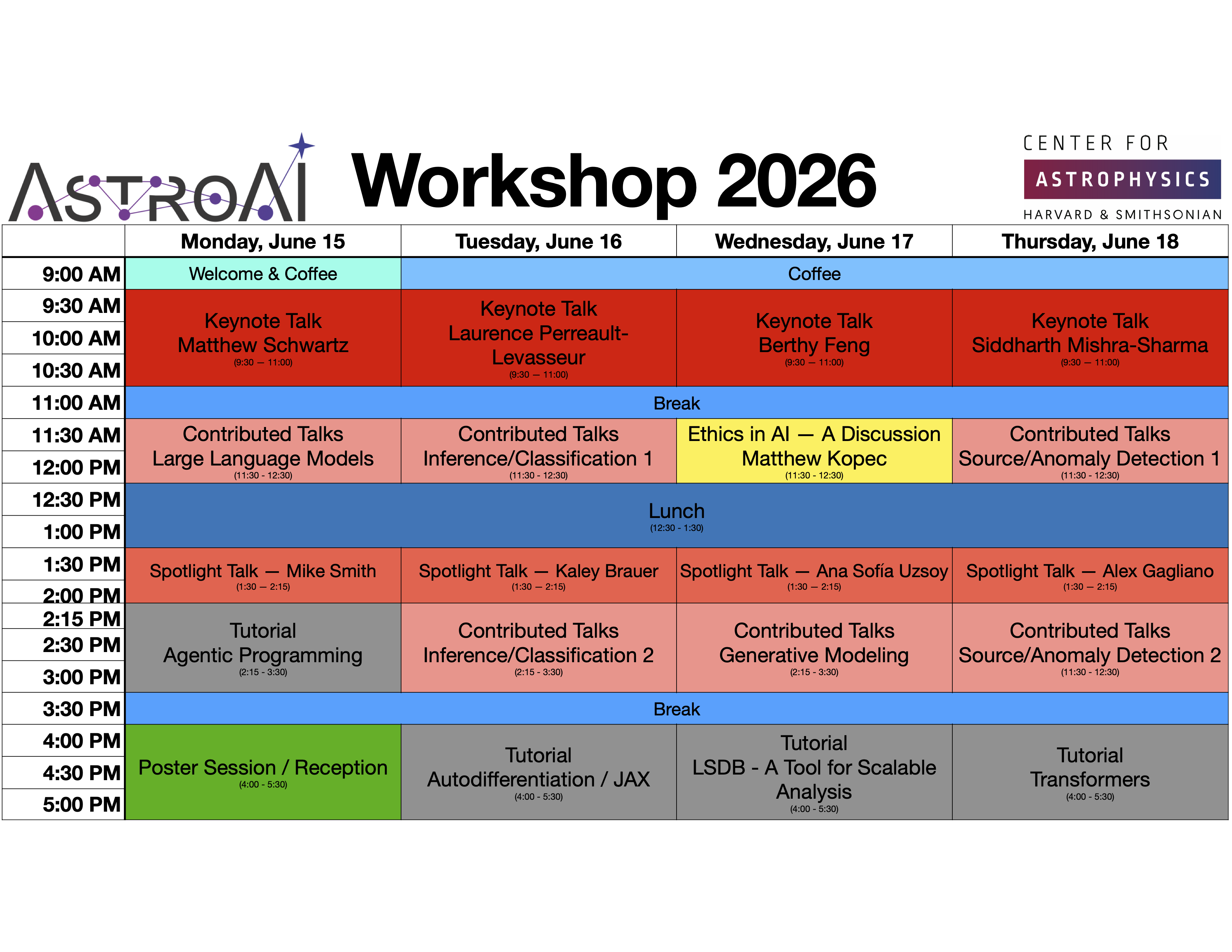
Schedule:
Monday, June 15th, 2026
9:00 am to 9:30 am
Welcome and coffee (Opening Remarks from AstroAI Director Cecilia Garraffo)
Phillips Auditorium
9:30 am to 11:00 am
Keynote Speaker:
Matthew Schwartz (Harvard University)
Title:
The Evolution of Science in the Age of AI
Phillips Auditorium
11:00 am to 11:30 am
Break
Phillips Auditorium
11:30 am to 12:30 pm
Contributed Talks: Large Language Models
Speaker 1:
Milan Pesta (Anomaly Detection in ASAS-SN Using Visual Embeddings and Agent-Driven Active Learning)
Speaker 2:
Zesen Huang (Democratizing Astrophysical Research with AI Agents: Lessons from Heliophysics)
Speaker 3:
Chayan Chatterjee (From Speech to Spacetime: Repurposing Audio Foundation Models for Gravitational Wave Detection)
Phillips Auditorium
12:30 pm to 1:30 pm
Lunch
Lobby/Atrium
1:30 pm to 2:15 pm
Spotlight Speaker:
Mike Smith (AstroAI/CfA)
Title:
The Platonic Universe: Do Foundation Models See the Same Sky?
Phillips Auditorium
2:15 pm to 3:30 pm
Tutorial:
Rocco Di Tella (AstroAI/CfA)
Title:
Introduction to Agentic Coding for Researchers
Phillips Auditorium
3:30 pm to 4:00 pm
Break
Phillips Auditorium
4:00 pm to 5:30 pm
Poster Session
Poster 1:
Anshuman Acharya (SCHARF: ML-based Super-Resolution for Bridging the galaxy-IGM connection at the Epoch of Reionization)
Poster 2:
Atal Agrawal (Beyond Pattern Matching: Bridging the Sim-to-Real Gap in Transient Flare Verification Using Vision Language Models)
Poster 3:
Vaanya Ahuja (Predicting exoplanet radius based on host star orbital parameters)
Poster 4:
Aleksandr Belotserkovtsev (Super-Resolving Euclid to Find Strong Gravitational Lenses)
Poster 5:
Srinadh Reddy Bhavanam (Fast GRB Localization from Raw Compton Events with Physics-Guided Implicit Neural Representations)
Poster 6:
Yang Cheng (A Multi-modal Learning Framework for JWST Imaging and Low-Resolution Spectra)
Poster 7:
Emma Chickles (Time encoding for irregularly sampled light curves)
Poster 8:
Tirthankar De (Modelling Hydrodynamics of Self Gravitating Molecular Clouds using Physics Informed Neural Networks)
Poster 9:
Ruobing Dong (Neural-network-based forward modeling of accretion disks)
Poster 10:
Braden Draucek (Towards an Understanding of AGN UV-NIR Spectra Using a Physically Motivated Spectral Decomposition Neural Network)
Poster 11:
Kshitij Duraphe (The Platonic Universe: Do Foundation Models See the Same Sky?)
Poster 12:
Anmol Gandhi (Pulsar Passage: Predicting Dynamical and Environmental Impacts on the Solar System)
Poster 13:
Sara Gholamhoseinian (Calibrated Selection Functions for Binary Black Holes via Normalizing Flows)
Poster 14:
Akum Gill (Stress Testing a Simulation-Based Inference Approach to Weak Lensing Galaxy Cluster Mass Inference)
Poster 15:
Yash Gondhalekar (Fast and Flexible Unsupervised Characterization of Astronomical Time Series with Multi-Time Attention)
Poster 16:
Alberto Guirado (AstroDetector: Comparing CNN and Random Forest Classifiers for Gravitational Lens Detection in Astronomical Imagery)
Poster 17:
Paridhi Jain (A General ML Framework for Diagnosing Physics Tensions in the Multi-Probe Era)
Poster 18:
Nishu Karna (A Foundation Model Approach to Solar Filament Detection)
Poster 19:
Dakshesh Kololgi (Learning the Cosmic Web: Inferring Cosmic Web Environments of Galaxies from Surveys)
Poster 20:
Rhea Senthil Kumar (PLANT: Conditional Generative Models for Fast Gravitational-Wave Population Synthesis)
Poster 21:
Jiaming Pan (Evaluating Diffusion Models for Cosmological Simulation Data: Memorization, Generalization, and Scientific Fidelity)
Poster 22:
Manuel Perez Carrasco (Plume Segmentation from MethaneSAT with Cross-Sensor Transfer Learning and Physics-Informed Postprocessing)
Poster 23:
Biju Saha (Identifying lopsidedness in spiral galaxies using Deep Convolutional Neural Network)
Poster 24:
Rajit Shrivastava (BRAHMa: Bar Recognition And Hatching using MAchine learning)
Poster 25:
Nicolas Waehner (Machine learning for exoplanet detection using the radial velocity method)
Wolbach Conference Space
5:30 pm to 7:30 pm
Reception
Wolbach Conference Space
Tuesday, June 16th, 2026
9:00 am to 9:30 am
Coffee
Phillips Auditorium
9:30 am to 11:00 am
Keynote Speaker:
Laurence Perreault-Levasseur (Université de Montréal)
Title:
TBA
Phillips Auditorium
11:00 am to 11:30 am
Break
Phillips Auditorium
11:30 am to 12:30 pm
Contributed Talks: Inference/Classification 1
Speaker 1:
Derick F. Tangap (Cross-Scale Parameter Inference using Reinforcement Learning within a Centripetal Reference Framework)
Speaker 2:
Angelo Ricarte (Observational Signatures of Flux Eruption Events in Black Hole Accretion Flows)
Speaker 3:
Ming-Shau Liu (Continuous Representations of Baryonic Feedback for Robust Inference from Multiple Simulation Suites)
Phillips Auditorium
12:30 pm to 1:30 pm
Lunch
Lobby/Atrium
1:30 pm to 2:15 pm
Spotlight Speaker:
Kaley Brauer (Harvard University)
Title:
How Do We Know What an AI System Is Thinking?
Phillips Auditorium
2:15 pm to 3:30 pm
Contributed Talks: Inference/Classification 2
Speaker 1:
Shunyuan Mao (Self-Supervised Neural Networks for High-Resolution Radio Imaging)
Speaker 2:
Estuti Shukla (Identifying Spacetimes using Neural Networks)
Speaker 3:
Alicia Martin (Symbolically regressing dark matter halo profiles using weak lensing)
Speaker 4:
Kianoosh Tahani (From Clouds to Stars: Determining Star Formation Efficiency via Stochastic Modeling and Machine Learning)
Phillips Auditorium
3:30 pm to 4:00 pm
Break
Phillips Auditorium
4:00 pm to 5:30 pm
Tutorial:
Phillip Cargile (AstroAI/CfA)
Title:
Accelerated Computation with Auto-Differentiation: AD/PyTorch/JAX
Phillips Auditorium
Wednesday, June 17th, 2026
9:00 am to 9:30 am
Coffee
Phillips Auditorium
9:30 am to 11:00 am
Keynote Speaker:
Siddharth Mishra-Sharma (Boston University)
Title:
TBA
Phillips Auditorium
11:00 am to 11:30 am
Break
Phillips Auditorium
11:30 am to 12:30 pm
Ethics Discussion:
Matthew Kopec (Harvard University)
Title:
Including AI Agents on Scientific Teams: Some Open Ethical Questions
Phillips Auditorium
12:30 pm to 1:30 pm
Lunch
Lobby/Atrium
1:30 pm to 2:15 pm
Spotlight Speaker:
Ana Sofía Uzsoy (AstroAI/Harvard University)
Title:
Manifold learning for cosmic structures
Phillips Auditorium
2:15 pm to 3:30 pm
Contributed Talks: Generative Modeling
Speaker 1:
Leena Iwamoto (Learning to Jet: A 3-D UNet Enabled Subgrid Model for AGN Jet Feedback in Cosmological Simulations)
Speaker 2:
Sacha Perry-Fagant (Inference of Star Formation and Metallicity Histories from Galaxy Spectra with Score-Based Models)
Speaker 3:
Fatemeh Hafezianzadeh (An AI super-resolution field emulator for cosmological hydrodynamics: the Lyman-α forest)
Phillips Auditorium
3:30 pm to 4:00 pm
Break
Phillips Auditorium
4:00 pm to 5:30 pm
Tutorial:
Konstantin Malanchev (CMU / LINCC Frameworks)
Title:
LSDB - A Tool for Scalable Analysis
Phillips Auditorium
Thursday, June 18th, 2026
9:00 am to 9:30 am
Coffee
Phillips Auditorium
9:30 am to 11:00 am
Keynote Speaker:
Berthy Feng (IAIFI)
Title:
TBA
Phillips Auditorium
11:00 am to 11:30 am
Break
Phillips Auditorium
11:30 am to 12:30 pm
Contributed Talks: Source/Anomaly Detection 1
Speaker 1:
Drew Oldag (Hyrax - A low-code solution for rapid experimentation with machine learning and unsupervised discovery in astronomy.)
Speaker 2:
Konstantin Malanchev (Scalable multi-modal catalog analysis with LSDB framework and HATS catalog format)
Speaker 3:
Pablo Mercader Perez (Disentangling Physics and Measurement Artifacts in Multi-Sensor Astrophysical Data)
Phillips Auditorium
12:30 pm to 1:30 pm
Lunch
Lobby/Atrium
1:30 pm to 2:15 pm
Spotlight Speaker:
Alex Gagliano (IAIFI / AstroAI)
Title:
TBA
Phillips Auditorium
2:15 pm to 3:30 pm
Contributed Talks: Source/Anomaly Detection 2
Speaker 1:
Hurum Maksora Tohfa (AIDonut : First Real-Time Neural Network Control of Telescope Active Optics the Vera Rubin Observatory)
Speaker 2:
Steven Dillmann (Terminal-Bench-Science: Evaluating AI Agents on Computational Workflows in the Natural Sciences)
Speaker 3:
Nico Bers (Ingredients of Our Black Hole's Diet: Using Unsupervised Learning to Correlate Different Gas Phases in the Center of the Milky Way)
Speaker 4:
Adiba Amira Siddiqa (Extracting Spectroscopic Information from Imaging and Photometry using Probabilistic Machine Learning)
Phillips Auditorium
3:30 pm to 4:00 pm
Break
Phillips Auditorium
4:00 pm to 5:30 pm
Tutorial:
Manuel Perez Carrasco (AstroAI/CfA)
Title:
Introduction to Transformers
Phillips Auditorium
Visual Schedule:
-->
×
A new version of content is available.
Update